Why Squash Deserves Prime Real Estate in Your Garden
If you've ever watched a single squash seed turn into a sprawling, fruit-heavy vine that takes over half a raised bed, you already know: this genus doesn't do anything halfway. Cucurbita — the botanical family behind every squash you've ever roasted, stuffed, or spiralized — is one of the oldest cultivated crops in the Americas, with archaeological evidence stretching back nearly 10,000 years. And for good reason. Few vegetables give you the sheer return on effort that squash does.
Whether you're growing summer squash for quick harvests all season long or planting winter squash to stock your pantry through the cold months, understanding how to grow squash well means bigger yields, fewer pest headaches, and better flavor on your plate. This guide breaks down everything — from choosing the right varieties and planting from seed, to dealing with the dreaded squash vine borer, timing your harvest, and curing winter squash for months of storage.

Summer vs. Winter Squash: What's Actually Different?
The names are misleading. Both summer and winter squash are warm-season crops that you plant after your last frost. The distinction is about when you harvest and how long they store.
Summer squash is picked young — thin-skinned, tender, and eaten within days of harvest. Think zucchini, yellow crookneck, and pattypan. They grow fast, produce continuously, and the plants are generally more compact (bush-type).
Winter squash is left on the vine until the rind hardens and the stem dries. These are your butternut, acorn, spaghetti, delicata, and Hubbard types. They take longer to mature (80–110 days vs. 45–65 for summer types), but they store for months in a cool, dry place — no freezer required.
Both belong to the genus Cucurbita, but they span different species. Most summer squash and some winter types (like acorn and delicata) are Cucurbita pepo. Butternut is Cucurbita moschata. Hubbard falls under Cucurbita maxima. This matters for cross-pollination and disease resistance, which we'll get into later.
Top Squash Varieties Worth Growing
Summer Squash Picks
Yellow Crookneck — The classic summer squash with a curved neck and bumpy golden skin. Prolific producer, great for sautéing, grilling, or frying. Ready in about 50 days. The flavor is mild and buttery, especially when picked at 4–6 inches (10–15 cm).
Pattypan (Scallop) — Those adorable flying-saucer-shaped squash that look like they belong in a fairytale garden. Pick them small — 2–3 inches (5–8 cm) across — for the best texture. They come in white, yellow, and green varieties. Excellent stuffed and roasted.
Cousa — If you haven't tried this Middle Eastern variety, you're missing out. Cousa is shorter and rounder than standard zucchini, with denser flesh that holds up beautifully to stuffing and coring. It's the squash of choice for kousa mahshi (stuffed squash) across the Levant. Matures in about 50 days and produces generously.
And of course, there's zucchini — the summer squash that needs no introduction. If you're new to growing summer squash, that's your starting point.

Winter Squash Picks
Butternut — The workhorse of winter squash. Tan, bell-shaped, with dense orange flesh that's sweet and nutty. Stores up to six months when properly cured. 'Waltham Butternut' is the gold-standard cultivar — reliable, productive, and resistant to vine borers thanks to its C. moschata genetics.
Acorn — Small, dark green, deeply ribbed. Perfect for halving and roasting with butter and brown sugar. Shorter storage life than butternut (about 2–3 months), but the flavor is hard to beat. 'Table Queen' is the classic cultivar.
Spaghetti — The novelty that became a staple. Bake or boil the whole fruit, then scrape out the flesh — it separates into noodle-like strands. A favorite for low-carb pasta substitutes. About 100 days to maturity.
Delicata — Cream-colored with green stripes, and the skin is thin enough to eat after roasting. Sweet, creamy flavor. Doesn't store as long as butternut (6–8 weeks), so eat these first from your winter stash. 'Honey Boat' is an excellent improved cultivar.
Hubbard — The behemoth. These can weigh 15–40 pounds (7–18 kg) with a hard, warty, blue-gray rind. The flesh is dry and sweet — ideal for pies. 'Blue Hubbard' is the classic, and its thick shell means storage of 5–6 months. Fair warning: you'll need a cleaver or a drop from the porch to crack one open.

How to Grow Squash from Seed
Timing and Soil Prep
Squash is a warm-season crop. Period. Seeds won't germinate in cold soil, and transplants will sulk and stall if you jump the gun. Wait until soil temperatures hit at least 65°F (18°C) — ideally 70°F (21°C) — before direct sowing. In most areas, that's 1–2 weeks after your last frost date.
If you want a head start, sow seeds indoors 3–4 weeks before transplanting. Use peat pots or soil blocks — squash roots don't love being disturbed, so anything you can plant directly into the ground works best.
Squash is a heavy feeder. Before planting, work 2–3 inches (5–8 cm) of compost or well-rotted manure into the top 8–10 inches (20–25 cm) of soil. The ideal pH is 6.0–6.8. If your soil is heavy clay, raised beds or mounded rows make a real difference for drainage.
Spacing: Hills vs. Rows
There are two classic approaches, and both work — it depends on your space and style.
Hill planting is the traditional method and still the best for most home gardeners. Create mounds about 12 inches (30 cm) high and 18–24 inches (45–60 cm) across. Space hills 4–6 feet (1.2–1.8 m) apart for bush types (summer squash) and 6–8 feet (1.8–2.4 m) apart for vining types (winter squash). Plant 4–5 seeds per hill, 1 inch (2.5 cm) deep. Once seedlings have two true leaves, thin to the best 2–3 per hill.
Hills warm up faster in spring, drain better, and give those sprawling vines room to run. They also make it easier to target water and fertilizer right where the roots are.
Row planting works better for larger-scale growing or if you're using drip irrigation. Space bush varieties 24–36 inches (60–90 cm) apart in rows 4–5 feet (1.2–1.5 m) apart. Vining winter types need 36–48 inches (90–120 cm) between plants and 6–8 feet (1.8–2.4 m) between rows.

Watering and Feeding
Squash needs consistent, deep watering — about 1–2 inches (2.5–5 cm) per week. Water at the base of the plant, not overhead. Wet foliage is an open invitation for powdery mildew. Drip irrigation or soaker hoses are your best bet.
Side-dress with compost or a balanced organic fertilizer when the first flowers appear, and again when fruit starts setting. For winter squash specifically, reduce nitrogen once fruits are developing — too much pushes leafy growth at the expense of fruit.
Pollination: The Step Most Guides Skip
Here's something that trips up a lot of first-time squash growers: you get gorgeous yellow flowers, maybe even tiny fruit forming, and then — the baby fruit shrivels and drops off. What happened? Poor pollination.
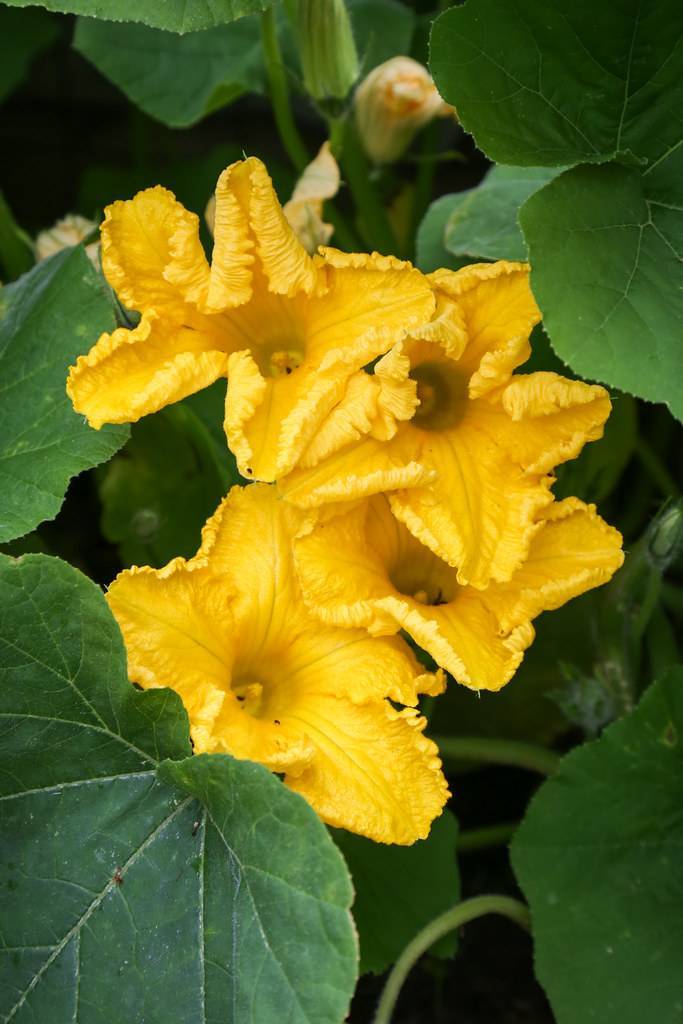
Squash produces separate male and female flowers on the same plant. Males show up first (on thin stems), and females follow a week or so later (look for the tiny fruit at the base of the flower). Bees need to carry pollen from male to female flowers for fruit to set. No bees, no squash.
If you're seeing fruit drop, try hand-pollinating. Pick a fresh male flower in the morning, peel back the petals, and gently dab the pollen onto the stigma inside the female flower. It takes 30 seconds and works remarkably well. Do this for a few days running and you'll see the difference.
Growing pollinator-friendly plants nearby helps too — borage, marigolds, and zinnias all bring bees into the patch.
The Two Biggest Squash Enemies (and How to Beat Them)
Squash Vine Borer
If there's one pest that makes squash growers lose sleep, it's the squash vine borer (Melittia cucurbitae). The adult is a moth that looks like a wasp — red-orange body, clear wings — and it lays tiny brown eggs at the base of squash stems in early summer. The larvae bore into the stem and feed from the inside, causing sudden wilting that looks exactly like drought stress. By the time you notice, the vine is often beyond saving.
Prevention is everything here.
- Row covers: Cover plants with floating row covers from transplant until flowering begins. This physically blocks the moth from laying eggs. Remove covers when flowers open so bees can pollinate.
- Aluminum foil wraps: Wrap the base of stems (bottom 4–6 inches / 10–15 cm) with aluminum foil to prevent egg-laying.
- Bt injections: If you catch an infestation early, inject Bacillus thuringiensis (Bt) into the stem at the entry point using a syringe.
- Succession planting: Plant a second round of summer squash in early July. The first generation of borers will have already passed their peak.
- Choose resistant species: Cucurbita moschata varieties (butternut, tromboncino) have harder stems and are naturally more resistant to vine borers than C. pepo types.
Powdery Mildew
That white, powdery coating on squash leaves in mid-to-late summer? That's powdery mildew, and it's practically inevitable in humid conditions. It won't kill the plant immediately, but it reduces photosynthesis, weakens the plant, and can shorten the harvest window.
- Air circulation: Proper spacing is your first defense. Crowded plants with poor airflow are mildew magnets.
- Water management: Water at the base, never overhead. Morning watering lets foliage dry before evening.
- Resistant varieties: Look for varieties with PM (powdery mildew) resistance bred in — many modern hybrids have this.
- Organic sprays: A mix of 1 tablespoon baking soda + 1 teaspoon liquid soap per gallon (3.8 L) of water, sprayed weekly, can slow the spread. Neem oil works too, but apply in the evening to avoid leaf burn.
Keeping an eye on your plants — catching issues early before they spiral — is where tools like Tendra's AI disease diagnosis come in handy. Snap a photo of a suspicious leaf, get an identification, and know whether you're dealing with powdery mildew, downy mildew, or just normal leaf aging.
Harvesting: Timing Is Everything
Summer Squash
The number one mistake with summer squash? Waiting too long. These are meant to be picked small and tender.
- Yellow crookneck: 4–6 inches (10–15 cm) long, skin still glossy
- Pattypan: 2–3 inches (5–8 cm) across — once they get bigger than your palm, the skin toughens and seeds develop
- Cousa and zucchini: 6–8 inches (15–20 cm) — firm, with a slight sheen
Check plants every 1–2 days during peak production. Summer squash can go from perfect to baseball-bat-sized in 48 hours. Frequent picking also signals the plant to keep producing. Leave a monster on the vine and production slows dramatically.
Use a sharp knife or pruners — don't twist or pull, which can damage the stem and invite disease.
Winter Squash
Winter squash is the opposite game: patience. Leave it on the vine as long as possible.
- Rind test: Press your fingernail into the skin. If it dents easily, it's not ready. A mature winter squash has a hard rind that resists puncture.
- Stem test: The stem connecting the fruit to the vine should be dry and corky — not green and fleshy.
- Color: The ground spot (where the fruit sits on the soil) should be deep cream or orange, not white or pale green.
- Days to maturity: Count from transplant or germination. Most winter squash needs 80–110 days. Don't rush it.
Harvest before a hard frost. A light frost won't damage mature fruit, but a hard freeze will compromise storage quality. Cut the stem with pruners, leaving 2–3 inches (5–8 cm) attached — never carry winter squash by the stem, which can break and create an entry point for rot.
Curing Winter Squash for Long-Term Storage
This is the step that separates a squash that lasts two weeks from one that lasts six months. Curing hardens the skin, heals minor scratches, and concentrates sugars for better flavor.
How to cure:
- After harvest, wipe off any soil (don't wash — moisture invites mold).
- Place squash in a warm, well-ventilated spot — 80–85°F (27–29°C) with good air flow. A covered porch, greenhouse, or sunny room works.
- Cure for 10–14 days. Butternut and Hubbard types benefit from the full two weeks. Acorn and delicata don't need curing and can actually lose quality from it — move those straight to cool storage.
Storage conditions: After curing, store in a cool, dry place — 50–55°F (10–13°C) with low humidity. A basement, unheated room, or garage (if it doesn't freeze) works well. Don't stack them; air needs to circulate around each fruit. Check monthly and use any that show soft spots first.
Properly cured and stored, butternut can last 5–6 months. Hubbard even longer. That's fresh, homegrown squash from October well into March — no freezer required.
Sam's Story: From Overwhelmed to Overloaded (In the Best Way)
Sam from San Diego started with two butternut squash plants his first year in a community garden. "I had no idea what I was doing," he says. "I planted them way too close together — 2 feet apart — and they turned into this tangled jungle. I couldn't even find the fruit under all the leaves."
Year two, Sam spaced his hills 8 feet apart, added trellising for his delicata vines, and used Tendra's community feature to connect with a nearby gardener who had been growing C. moschata varieties for years. That neighbor tipped him off to wrapping stems with foil for vine borer prevention — something Sam had never heard of.
"That one tip saved my whole crop," Sam says. "I harvested 40 pounds of butternut and 15 delicata that year. Cured them in the garage, and we were eating homegrown squash through February. My wife thought I'd lost my mind, but even she admitted the soup was better than anything from the store."
That's the thing about squash — once you dial in the basics, the plant does the heavy lifting.
Putting It All Together: Your Squash-Growing Checklist
- Choose your varieties: Mix summer and winter types for continuous harvests and long-term storage.
- Start right: Direct sow after soil hits 65°F (18°C), or start indoors 3–4 weeks early in peat pots.
- Space generously: 4–6 feet (1.2–1.8 m) for bush types, 6–8 feet (1.8–2.4 m) for vining types.
- Feed heavily: Amend with compost before planting; side-dress at flowering and fruit set.
- Water at the base: 1–2 inches (2.5–5 cm) per week, never overhead.
- Protect against vine borers: Row covers, foil wraps, resistant species.
- Manage mildew: Air circulation, proper spacing, organic sprays if needed.
- Harvest summer squash young: Small, glossy, every 1–2 days.
- Harvest winter squash late: Hard rind, dry stem, before hard frost.
- Cure winter types: 10–14 days at 80–85°F (27–29°C), then cool storage.
Growing squash isn't complicated, but the details matter. Get the spacing right, stay ahead of vine borers, and respect the harvest timing differences between summer and winter types, and you'll have more squash than you know what to do with. Your vegetable garden will be stocked from June through March.
Discover smart care reminders and local growing advice with Tendra — where local gardeners connect and thrive.