There's something deeply satisfying about walking into your garden in October and seeing fat, orange pumpkins sitting on the vine, ready to pick. That moment doesn't happen by accident — it starts right now, in early summer, when the soil is warm and the growing season stretches out ahead of you. If you've been wondering how to grow pumpkins that actually produce, you're in the right place. Whether you want a front-porch Jack-o'-lantern, the sweetest pie filling you've ever tasted, or a behemoth that turns heads at the county fair, this guide walks you through every step from seed to harvest.
Pumpkins belong to the Cucurbita genus — primarily Cucurbita pepo (most carving and mini varieties) and Cucurbita maxima (giant types and many cooking varieties). They're warm-season crops that need 100 to 120 frost-free days, full sun, and a lot more space than most gardeners expect. But give them what they want, and they'll reward you with one of the most satisfying harvests in the garden.
How to Grow Pumpkins: Choosing the Right Variety
Before you drop a single seed into soil, pick your variety with purpose. Pumpkins aren't one-size-fits-all, and the difference between a Sugar Pie and an Atlantic Giant is the difference between a countertop and a flatbed truck.
Jack-o'-Lantern Types (Cucurbita pepo)
These are the classic 10-to-25-pound (4.5-to-11 kg) carving pumpkins — 'Howden,' 'Connecticut Field,' 'Magic Lantern.' They have sturdy handles (stems), flat bottoms, and smooth-ish skin that takes a knife well. Expect 90 to 110 days to maturity. If your goal is a porch full of carved faces by Halloween, this is your category.
Sugar Pie and Cooking Pumpkins
Smaller, denser, and sweeter than their carving cousins. 'Sugar Pie' (also called 'New England Pie') runs about 6 to 8 pounds (2.7-3.6 kg) with thick, smooth flesh that roasts beautifully. 'Winter Luxury' has a netted rind and arguably the best flavor of any pie pumpkin — silky texture, rich sweetness. 'Cinderella' (Rouge Vif d'Étampes) looks like it rolled out of a fairy tale and makes an outstanding soup. These mature in 100 to 115 days.
Atlantic Giant (Cucurbita maxima)
The competitive grower's obsession. 'Dill's Atlantic Giant' holds the genetics for world-record pumpkins exceeding 2,500 pounds (1,134 kg). Growing one is a season-long project involving soil testing, specialized fertilizing, daily vine training, and a level of dedication that borders on athletic training. Not for the casual gardener — but undeniably fun if you're up for the challenge.
Mini and Ornamental Pumpkins
'Jack Be Little,' 'Baby Boo,' 'Wee-B-Little' — these palm-sized pumpkins mature fast (85 to 100 days), produce heavily, and work great in containers if you're short on space. They're perfect for table decorations, and kids love growing them. The vines are still vigorous, though — even a "mini" pumpkin wants to sprawl.
When to Plant Pumpkins (Timing Is Everything)
Pumpkins are frost-intolerant, period. Soil temperature needs to be at least 65°F (18°C) for germination, and the plants will stall or die if nighttime temps drop below 50°F (10°C). Here's the real question when planning your pumpkin planting guide: when do you want to harvest?
Count backward from your target harvest date. If you want pumpkins by mid-October, and your variety takes 110 days, you need seeds in the ground by late June. For most of the US:
- Zones 3-5: Plant late May through mid-June (short window — choose varieties under 100 days)
- Zones 6-7: Plant late May through early July
- Zones 8-9: Plant June through mid-July
- Zone 10+: Plant July for a late fall harvest, or try a spring crop (February-March) before summer heat hits
If you're in June right now and haven't started, you're not late — you're right on schedule for most varieties. Just don't wait until August and wonder why you're harvesting green golf balls in November.

Soil Prep: Building the Foundation
Pumpkins are heavy feeders with deep roots, and they'll tell you exactly how your soil is doing. Weak vines, yellow leaves, and undersized fruit usually mean you skipped the soil prep.
Start 2 to 3 weeks before planting:
- Test your soil. Pumpkins prefer a pH of 6.0 to 6.8. Most county extension offices offer free or cheap testing.
- Amend heavily. Work 4 to 6 inches (10-15 cm) of aged compost into the top 12 inches (30 cm) of soil. Pumpkins love organic matter — it feeds the soil biology, improves drainage in clay, and retains moisture in sand.
- Build mounds or hills. Traditional pumpkin planting uses raised mounds about 12 inches (30 cm) high and 3 feet (90 cm) across. These warm up faster, drain better, and give roots extra depth. Plant 4 to 5 seeds per hill, then thin to the strongest 2 to 3 seedlings.
- Pre-fertilize. Mix a balanced granular fertilizer (10-10-10) into the mound, plus a handful of bone meal for phosphorus. Giant pumpkin growers often add mycorrhizal inoculant to boost root networks.
If you've been building your soil with regular composting, pumpkins are the ultimate payoff crop — they'll convert that rich, living soil into vigorous growth almost visibly.
Spacing: They Need More Room Than You Think
This is where first-time pumpkin growers get ambushed. A single pumpkin vine can extend 20 to 30 feet (6-9 m) in every direction. That cute little seedling will become a space-devouring monster by August.
Recommended spacing:
- Standard varieties: Hills spaced 8 to 12 feet (2.4-3.6 m) apart, with rows 10 to 15 feet (3-4.5 m) apart
- Giant pumpkins: One plant per 1,000+ square feet (93+ sq m) — yes, really
- Mini/bush varieties: 4 to 6 feet (1.2-1.8 m) apart; semi-bush types like 'Sugar Treat' need less room but still sprawl
- Container growing: Only realistic for mini varieties — use at least a 20-gallon (75 L) container
If space is tight, train vines in one direction along a fence line, or grow vertically on a sturdy trellis (minis only — a 15-pound pumpkin will snap most structures). You can also interplant with fast-maturing crops like lettuce or radishes that will be harvested before the vines take over.
Growing Pumpkins from Seed: Planting Day
Direct sowing is the standard approach — pumpkins don't love transplanting because their roots are sensitive. But if your growing season is short (zones 3-5), start seeds indoors in 4-inch peat pots 2 to 3 weeks before your last frost date, then transplant the whole pot to avoid root disturbance.
For direct sowing:
- Push seeds 1 inch (2.5 cm) deep into the mound, pointed end down
- Plant 4 to 5 seeds per hill
- Water gently but thoroughly — soil should be moist, not waterlogged
- Expect germination in 5 to 10 days at soil temps of 70-85°F (21-29°C)
- Once seedlings have 2 true leaves, thin to the 2 to 3 strongest per hill by snipping (don't pull — you'll disturb the roots of the keepers)
A surprising fact that catches many new growers off guard: pumpkin seeds are viable for 4 to 6 years when stored cool and dry, so last year's leftover packet is probably fine. Test germination by wrapping a few seeds in a damp paper towel for a week before committing to the garden.

Vine Management and Training
Once vines hit their stride in midsummer, they grow fast — sometimes 6 inches (15 cm) per day. Left unchecked, they'll invade your neighbor's yard, climb your fence, and smother anything in their path. That's where vine management comes in.
Redirecting vines: Gently reposition vines to keep them within your designated growing area. Do this in the afternoon when vines are slightly wilted and more pliable — morning vines are turgid and snap easily.
Burying nodes: Where leaf nodes touch the ground, the vine will send out secondary roots. Encourage this by burying nodes under a few inches of soil or compost. More roots mean more water and nutrient uptake, which means bigger fruit.
Pruning secondary vines: For larger fruit, prune tertiary (side-of-side) vines and limit each main vine to 1 to 2 developing pumpkins. Giant growers often limit the entire plant to a single fruit, directing all energy into one monster. For regular carving pumpkins, 3 to 4 fruit per plant is a reasonable target.
Protecting developing fruit: Slide a piece of cardboard, a wooden board, or a bed of straw under each developing pumpkin to prevent bottom rot from soil contact. Rotate the fruit gently every week or two to promote even shape — but stop rotating once the skin starts to harden.
Pollination: The Make-or-Break Moment
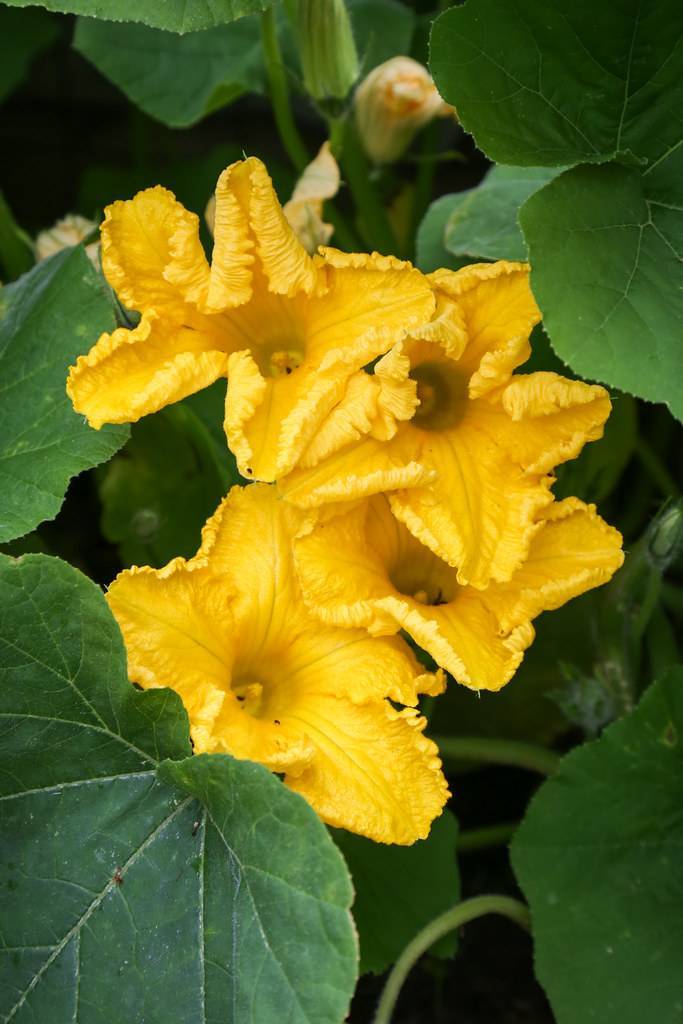
Pumpkins produce separate male and female flowers on the same plant. Males appear first (on thin straight stems), followed by females about a week later (identifiable by the small bulge — a baby pumpkin — at the base of the flower). Both open in the early morning and close by midday.

Pollination requires bees (or other pollinators) to transfer pollen from male flowers to female flowers. If you're noticing small fruit that yellows, shrivels, and drops — that's failed pollination, and it's the number-one complaint from new pumpkin growers.
Hand Pollination Tips
If pollinators are scarce in your garden, take matters into your own hands — literally:
- Early morning (6-9 AM), identify an open male flower
- Pick the male flower and peel back the petals to expose the pollen-covered anther
- Find an open female flower (look for the small round fruit at the base)
- Gently dab and roll the male anther directly onto the sticky stigma inside the female flower
- One male flower can pollinate 2 to 3 females
- Alternatively, use a small paintbrush or cotton swab to transfer pollen
Hand pollination is almost meditative once you get the hang of it, and it dramatically improves fruit set. It's also essential if you're growing in an urban area, on a balcony, or anywhere pollinator traffic is low. Planting pollinator-attracting companions like borage, marigolds, and zinnias nearby will help bring the bees to your patch naturally.
Water, Feed, Repeat
Pumpkins are thirsty. A mature plant needs 1 to 1.5 inches (2.5-3.8 cm) of water per week, and more during fruit development and hot spells. Deep, infrequent watering beats shallow daily sprinkles — you want moisture reaching those buried vine nodes and the deep taproot.
Watering rules:
- Water at the base, not overhead — wet leaves invite fungal disease
- Drip irrigation or soaker hoses are ideal
- Mulch heavily (4 inches / 10 cm of straw or wood chips) to retain moisture and suppress weeds
- Reduce watering 2 weeks before harvest to concentrate sugars and toughen the rind
Fertilizing schedule:
- Weeks 1-4 (vine growth): Higher nitrogen (fish emulsion, blood meal) to push leafy growth
- Weeks 5-8 (flowering and fruit set): Switch to phosphorus-heavy (bone meal, 5-10-5) to support blooms and fruit development
- Weeks 9-harvest (fruit sizing): Potassium boost (wood ash, kelp meal, 0-0-60) for rind hardening and sugar development
Tendra's smart care reminders can help you stay on top of this shifting fertilizer schedule — set custom alerts for each growth phase so you're not scrambling to remember when to switch from nitrogen to phosphorus.
Battling Powdery Mildew (Your Biggest Threat)
If you grow pumpkins long enough, you will deal with powdery mildew. It's not a question of if, but when. This fungal disease appears as white, powdery spots on leaves, usually starting in late summer when days are warm and nights are cool with high humidity.
Prevention (start before you see it):
- Space plants properly for airflow — crowded vines are mildew magnets
- Water at soil level, never overhead
- Choose resistant varieties when possible ('Racer,' 'Magic Lantern,' and many newer hybrids have improved resistance)
- Apply preventive sprays starting in mid-July:
Organic spray options:
- Milk spray: 40% milk to 60% water, sprayed weekly. Yes, really — the proteins in milk create an antiseptic effect when exposed to sunlight. Multiple university studies back this up.
- Neem oil: 1 tablespoon per gallon of water with a few drops of dish soap as emulsifier. Apply every 7-14 days.
- Potassium bicarbonate: 1 tablespoon per gallon of water. More effective than baking soda (sodium bicarbonate) and doesn't build up sodium in soil.
Treatment: Once mildew is established, you won't eliminate it — the goal shifts to slowing the spread. Remove the most heavily affected leaves (bag and trash them, don't compost), and spray remaining foliage aggressively. Healthy vines can power through moderate mildew and still ripen fruit, but a severe infection will weaken the plant and reduce pumpkin size and sugar content.
Other pests to watch: squash vine borers (frass at the base of stems — inject Bt into the stem), cucumber beetles (vector for bacterial wilt — hand-pick or use row cover early), and squash bugs (crush egg clusters on leaf undersides). Companion planting with nasturtiums and radishes can help deter some of these pests.
Harvest Timing: Patience Pays Off
The single most common mistake? Picking too early. An immature pumpkin won't develop more color or sweetness off the vine — what you cut is what you get.
Signs your pumpkin is ready (100-120 days from planting):
- Rind is the expected color for the variety (deep orange, white, etc.) and fully uniform
- Skin is hard — your fingernail shouldn't dent it
- The stem is starting to dry and brown
- The vine near the fruit is drying back
- When you thump it, it sounds hollow
- The bottom (ground spot) has turned from white to cream or yellow-orange
To harvest, use sharp pruners or a knife to cut the stem, leaving 3 to 4 inches (7.5-10 cm) of stem attached. Never carry a pumpkin by the stem — it will break off and create an entry point for rot. Cradle the body.

Curing and Storage: Making Your Harvest Last
Fresh-picked pumpkins can rot within weeks. Cured pumpkins last months. The difference is a simple 10-day process that hardens the skin and heals minor field damage.
Curing process:
- Place harvested pumpkins in a warm (80-85°F / 27-29°C), dry, well-ventilated spot for 10 days. A sunny porch, greenhouse, or even a warm garage works.
- Space them so they're not touching — air circulation prevents moisture buildup.
- After curing, wipe down with a dilute bleach solution (1 tablespoon per gallon of water) to kill surface mold spores.
- Move to cool (50-55°F / 10-13°C), dry storage. A basement, root cellar, or unheated room is ideal.
Storage life by type:
- Jack-o'-lanterns (thin skin): 1-2 months
- Pie pumpkins: 2-3 months
- 'Blue Hubbard' and thick-skinned C. maxima types: 4-6 months
- Mini ornamentals: 2-3 months (longer if uncut)
Sam from San Diego learned this the hard way his first year growing pumpkins. "I was so excited about my first real harvest — eight beautiful Sugar Pies — that I just stacked them in the garage and forgot about them," he told us. "Three weeks later, half of them were soft and moldy. The next year, I built a simple curing station on my covered patio — just a table with a fan for airflow — and those pumpkins lasted all the way through February. Same variety, completely different result. The curing step is non-negotiable." Sam now grows six varieties each season, saving seeds from his best performers and swapping with other growers in his area through Tendra's local gardening network.
Pumpkin Planting Guide: Quick-Reference Timeline
For a mid-October harvest in zones 6-8 (adjust forward or back for your zone):
- Late May / Early June: Prep soil, build mounds, amend with compost
- Mid-June: Direct sow seeds (or transplant indoor starts)
- Late June: Thin seedlings to 2-3 per hill; begin regular watering
- July: Vines run; side-dress with nitrogen; begin vine training and mulching
- Late July / Early August: Switch to phosphorus fertilizer; flowers appear; hand-pollinate if needed; begin mildew prevention sprays
- August: Fruit sizing; switch to potassium; place boards under developing fruit; manage pests
- September: Reduce water; let vines die back naturally; watch for harvest signs
- October: Harvest, cure, and store
Companion Planting for Pumpkins
Pumpkins play well with some neighbors and terribly with others. The classic "Three Sisters" planting — corn, beans, and squash (pumpkins qualify) — is one of the oldest companion planting systems in the world, and it works beautifully. Corn provides a vertical structure, beans fix nitrogen, and the sprawling pumpkin vines shade the soil to suppress weeds and retain moisture.
Other good companions: sunflowers (attract pollinators and provide partial shade), marigolds (deter beetles and nematodes), oregano and marjoram (repel squash bugs). Avoid planting near potatoes (compete for nutrients and can share blight) or fennel (inhibits growth of most neighboring plants).
Wrapping Up: Your Pumpkin Season Starts Now
Growing pumpkins from seed to harvest is a 100-to-120-day commitment that rewards patience, good soil, and a willingness to get your hands in the dirt early. The work you put in this month — prepping mounds, sowing seeds, planning your spacing — directly determines what your garden looks like in October.
Pick your varieties with intention, give them the space they genuinely need, stay ahead of powdery mildew, hand-pollinate if your bees are slacking, and cure properly after harvest. That's the formula. It's not complicated, but each step matters.
Whether you're growing a single Sugar Pie for Thanksgiving or racing to break 500 pounds with an Atlantic Giant, there's a pumpkin variety and a growing strategy that fits your garden. Track your planting dates, log your harvest weights, and connect with other growers in your zone — discover what's working in your area with Tendra, where local gardeners connect and thrive.