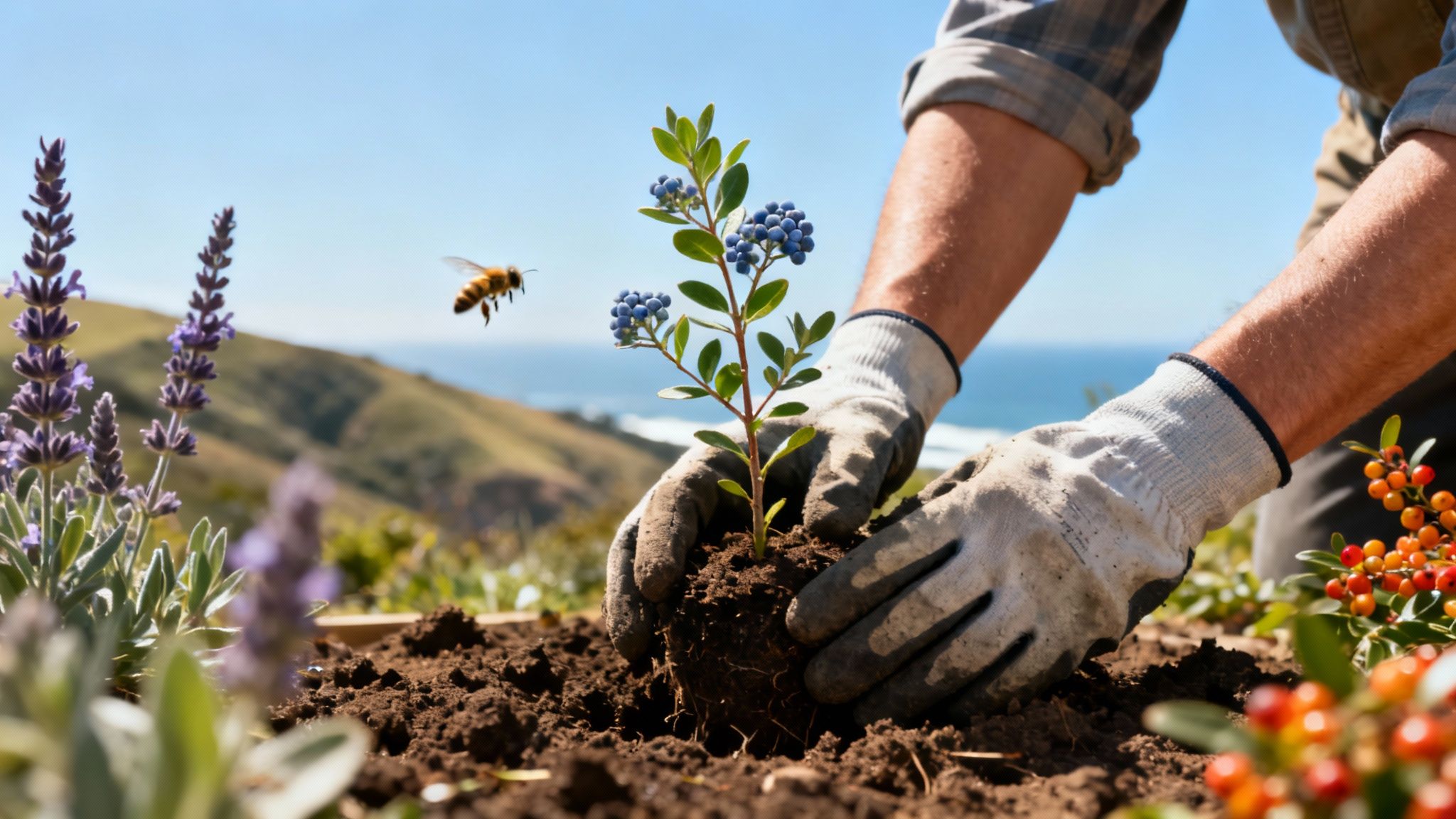
Have you ever looked at your garden in the middle of a scorching California summer and felt a wave of exhaustion? The constant watering, the battle against heat-stressed plants, and the nagging feeling you're fighting a losing battle against the climate can take the joy out of gardening. It's a common struggle for many of us.
But what if you could create a stunning garden that doesn't just survive, but actively thrives in our unique climate? What if the solution wasn't to fight nature, but to invite it in? This is the transformative power of california native plants. These are the resilient, beautiful species that have spent millennia perfecting the art of living here. They are your secret weapon for creating a vibrant, low-maintenance, and eco-friendly oasis that truly belongs. This guide will show you exactly how to get started.

Why Go Native? It's More Than Just Gardening
Choosing local flora is about so much more than just picking pretty flowers. It’s a shift in mindset—transforming your garden from a high-maintenance chore into a living ecosystem that gives back. When you plant natives, you're not just a gardener; you're an ecosystem builder.
This guide is your roadmap. You’ll learn how to:
Build a garden that practically takes care of itself, saving you water, time, and money.
Become a vital part of supporting local pollinators and wildlife, from hummingbirds to native bees.
Confidently select the perfect plants, like a vibrant California Lilac (Ceanothus) or a fragrant Black Sage (Salvia mellifera), for your specific spot in California.
Master the simple care techniques that ensure your native garden flourishes from day one.
Why Your Garden Needs California Native Plants
When you choose plants for your garden, it’s easy to focus on aesthetics first. But with california native plants, you're making a choice that goes far beyond looks. You are weaving a tough, resourceful, and beautiful ecosystem into your own backyard—one that's perfectly in sync with the local landscape.
Think of it this way: many common ornamental plants are like out-of-town visitors. They need constant coddling to feel at home, demanding special soil, frequent watering, and protection from the very climate they live in. Native plants, on the other hand, are home. They’ve spent thousands of years adapting to California's rhythm of wet winters and dry summers, evolving alongside our local soil, insects, and wildlife.
Save Water and Ditch the Constant Maintenance
One of the most immediate benefits of a native garden is water conservation—a true game-changer in a state where every drop counts.
Drought-Proof by Design: California natives have developed incredible deep root systems to find moisture, allowing them to thrive through long, hot summers with little to no extra water once established.
No More Fertilizer: Because they are adapted to our native soils, you can skip the endless cycle of feeding that many non-natives require to stay healthy.
Fewer Pests, Naturally: These plants have co-evolved with local insects and diseases, building up natural defenses over millennia. That means you can say goodbye to harsh chemical pesticides.
This built-in resilience frees you from the chore wheel of feeding, spraying, and pruning. You stop fighting against nature and start collaborating with it. For a deeper look at creating this kind of eco-friendly space, check out how to grow a better world with sustainable gardening practices.
Become a Cornerstone of Your Local Ecosystem
A native garden is far more than a collection of plants; it's a bustling habitat. These plants are the foundation of the local food web, providing essential food and shelter for countless local creatures.
Did you know California is a global biodiversity hotspot with over 6,000 native plant species—more than any other state in the U.S.? Even more astounding, about a third of those are endemic, meaning they exist here and nowhere else on Earth. When you plant them, you become a guardian of this incredible natural heritage.
By adding plants like Toyon (Heteromeles arbutifolia) or Western Redbud (Cercis occidentalis), you're rolling out the welcome mat for native pollinators and birds who rely on them for nectar, pollen, seeds, and shelter.
A garden filled with native plants is an invitation to life. You'll be amazed at the increase in visiting native bees, colorful butterflies, energetic hummingbirds, and cheerful songbirds—all finding a much-needed sanctuary in your yard.
Finding the Right Natives for Your Yard
With thousands of options, figuring out where to start can feel overwhelming. Imagine you're on a walk and spot a gorgeous, drought-tolerant shrub swarming with happy bees, but you have no clue what it is. This common roadblock can stop a great garden plan in its tracks.
This is where a tool like the Tendra app becomes your personal botanist. Its AI plant identification feature lets you snap a photo and get an instant ID. But it doesn't just give you a name; it provides the crucial details you need to decide if that plant is right for your garden, turning the hunt for perfect natives into a fun, achievable project.
Matching Plants to Your Slice of California
California isn't one landscape—it's a stunning patchwork of wildly different environments, from foggy coastal bluffs to sun-scorched inland valleys. Each region presents a unique set of rules for gardeners.
The golden rule for succeeding with california native plants is simple: 'right plant, right place.' This means choosing plants already hardwired to thrive in your specific local conditions. A plant that loves the cool, misty air of the coast will likely wither in the intense, dry heat of an inland desert.
Work With Your Environment, Not Against It
Identifying your local ecoregion is the single most important step toward a garden that practically takes care of itself. Instead of constantly fighting your climate, you’ll be choosing allies that already know how to succeed right where you live. This approach saves water, reduces frustration, and results in a garden that feels like a natural extension of the surrounding landscape.
Let's dive into some major ecoregions and spotlight plants that are perfectly at home in each.
Coastal Gardens: Ocean Breezes and Fog
Gardens on the coast experience moderate temperatures, high humidity, and occasional salt spray. The defining feature is marine fog, which provides moisture and shields plants from harsh sun. Plants native to this zone are tough, often with waxy or fuzzy leaves to manage moisture and deflect salt.
Top Picks for Coastal Gardens:
Beach Aster (Erigeron glaucus): A cheerful, low-growing perennial with lavender, daisy-like flowers. It thrives in full sun and well-draining soil.
Catalina Cherry (Prunus lyonii): This evergreen shrub provides glossy green foliage year-round and edible summer fruits, making it perfect for a privacy screen.
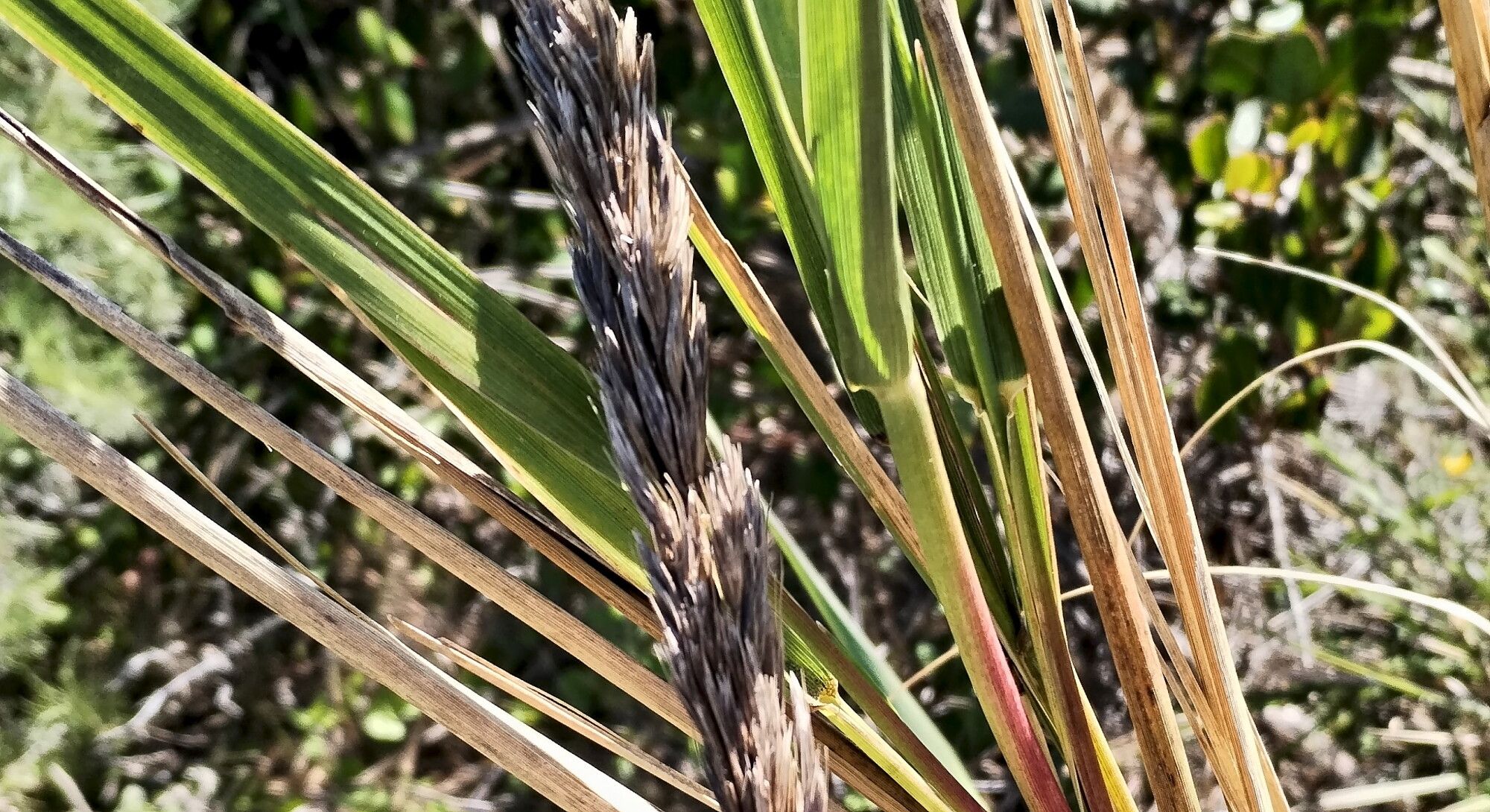
Canyon Prince Blue Rye (Leymus condensatus 'Canyon Prince'): A striking ornamental grass whose silvery-blue blades add beautiful, flowing texture to the garden.
Pro Tip: While USDA hardiness zones are a good starting point, they only measure winter cold. For California's varied climate, understanding your specific ecoregion provides a more accurate picture of what will truly flourish. Learn more in our guide to the USDA planting zone chart.
Inland Valleys: Hot Summers and Tough Clay
The Central Valley and other inland areas face hot, dry summers and cooler, sometimes frosty, winters. The soil is often heavy clay, a challenge for plants not adapted to it. Natives from this region are masters of water conservation with root systems that can muscle through dense soil.
Top Picks for Inland Gardens:
Western Redbud (Cercis occidentalis): A showstopper that explodes in brilliant magenta flowers in early spring, followed by signature heart-shaped leaves.
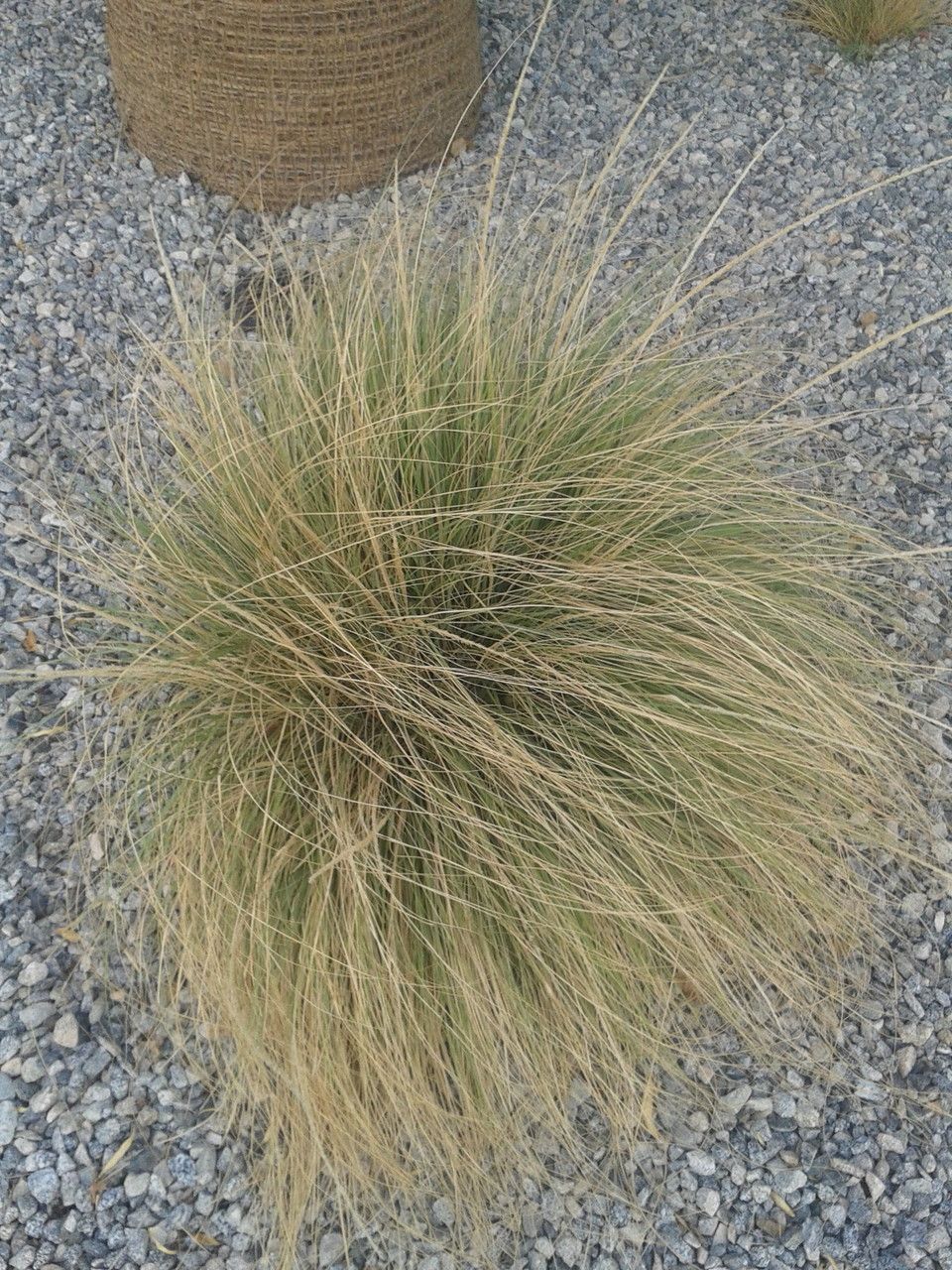
Deer Grass (Muhlenbergia rigens): A large, graceful bunchgrass that forms a fountain of slender leaves and sends up elegant flower spikes in summer.
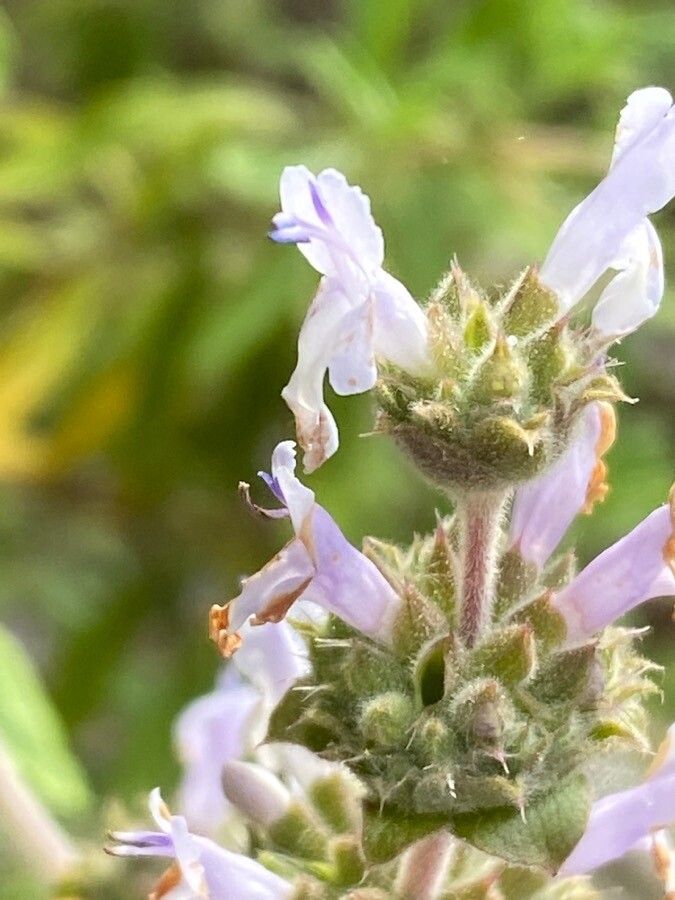
Black Sage (Salvia mellifera): A highly fragrant shrub that is a magnet for bees and hummingbirds, beloved for its resilience and whorls of pale blue or white flowers.
Desert Regions: Intense Sun and Scarce Water
Southern California's deserts are defined by intense heat, blazing sun, and minimal rain. The soil is typically sandy or rocky and drains instantly. Plants here are ultimate survivors, with adaptations like succulent leaves to store water and silvery foliage to reflect harsh sunlight.
Top Picks for Desert Gardens:
Desert Willow (Chilopsis linearis): Not a true willow, this gorgeous small tree produces fragrant, orchid-like flowers throughout the hottest summer months.
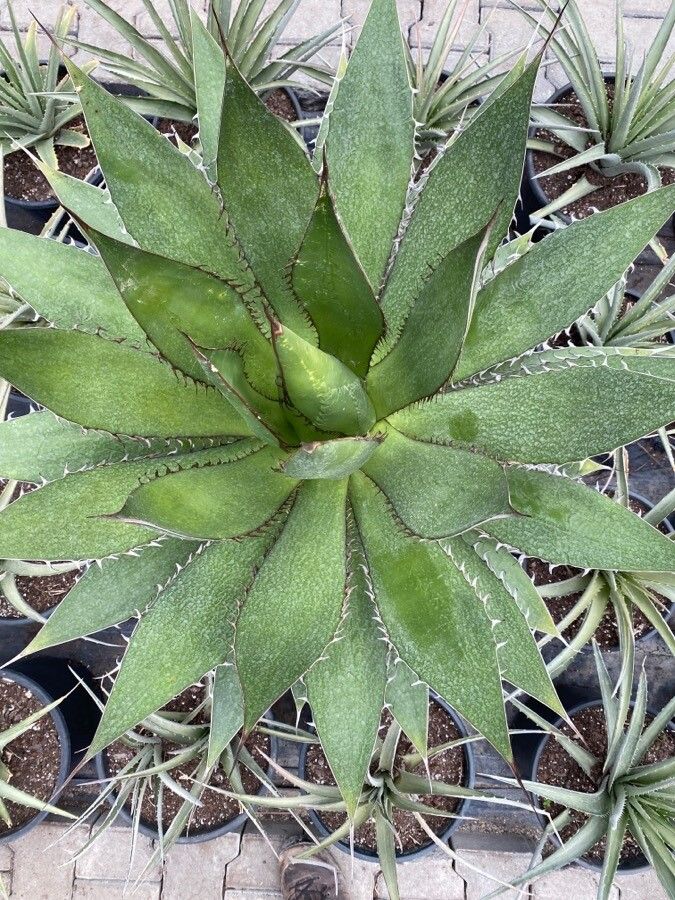
Shaw's Agave (Agave shawii): A dramatic succulent that forms a dense rosette of sharp, fleshy leaves, sending up a massive flower stalk once in its lifetime.
Screwbean Mesquite (Prosopis pubescens): A hardy, nitrogen-fixing tree that offers light, filtered shade—a precious commodity in the desert.
Connecting with other gardeners in your area is a fantastic way to see which california native plants are thriving in your specific microclimate. This is where a tool like Tendra’s Local Gardening Networks feature becomes invaluable, letting you see what’s working for your neighbors and share your own successes.
Top California Native Plants For Your Garden
Now for the fun part: picking the plants that will transform your yard into a thriving native landscape. Whether you have a sun-baked patch or a shady nook, we’ve got you covered with tried-and-true species that deliver stunning results without the fuss.
This visual guide is a great starting point for seeing how your garden fits into the bigger picture, which is the first step in making smart plant choices.
Understanding your climate zone helps narrow down the plant list significantly, setting you up for success from day one.
Plants For Full Sun and Drought Tolerance
These are the heavy lifters of the native garden. Once established, they thrive on intense heat and minimal water, forming the backbone of any water-wise landscape.
Toyon (Heteromeles arbutifolia): Often called Christmas Berry, this evergreen shrub is a year-round star. It has clusters of white summer flowers that mature into brilliant red berries, a critical winter food source for birds.
Manzanita 'Howard McMinn' (Arctostaphylos 'Howard McMinn'): One of the most adaptable and garden-friendly manzanitas. It's a fantastic evergreen with beautiful reddish bark, shiny green leaves, and charming pinkish-white flowers in late winter.
Matilija Poppy (Romneya coulteri): One of California's most spectacular natives, it produces enormous white flowers that look like fried eggs and can be up to 9 inches (23 cm) across. Bees go wild for it.
Flowering Shrubs For Shady Corners
Most gardens have tricky spots—under a large oak or along a north-facing wall—where the sun doesn't quite reach. These plants are adapted to lower light and will bring color to those overlooked corners.
Western Redbud (Cercis occidentalis): A true spectacle in early spring, this multi-trunked shrub erupts in a blaze of magenta flowers on its bare branches before its lovely heart-shaped leaves appear.
Catalina Cherry (Prunus lyonii): With dense, glossy, dark green leaves, this evergreen is a fantastic choice for a living privacy screen. It produces edible cherries and is surprisingly adaptable to different light levels.
Woolly Blue Curls (Trichostema lanatum): Known for its striking, fuzzy, deep blue flowers, this aromatic shrub is a hummingbird magnet. While it loves sun, it appreciates afternoon shade in hotter inland areas.
Superstars For Attracting Pollinators
If your goal is to create a buzzing, fluttering hub of activity, these plants are non-negotiables. They are powerhouses for supporting local bees, butterflies, and hummingbirds.
Penstemon 'Margarita BOP': A long-blooming perennial with beautiful sky-blue and lavender tubular flowers that hummingbirds find irresistible. It's tough, adaptable, and provides color for months.
'Bee's Bliss' Sage (Salvia 'Bee's Bliss'): This low-growing groundcover sage is a pollinator party. In spring, it's covered in whorls of lavender-blue flowers that are an absolute magnet for bees.
Red Buckwheat (Eriogonum grande var. rubescens): A compact plant with fuzzy gray leaves and adorable pom-poms of rosy-pink flowers. It blooms for months, providing a steady food source for butterflies and native bees.
Grasses and Groundcovers For Texture
Native grasses and groundcovers add structure, movement, and soft texture that ties everything together. They are perfect for filling gaps, suppressing weeds, and creating a natural, layered look.
Deer Grass (Muhlenbergia rigens): A large, graceful bunchgrass forming a dense clump of fine green leaves. In late summer, it sends up tall, slender flower spikes that add amazing vertical interest.
California Grape 'Roger's Red' (Vitis californica 'Roger's Red'): A vigorous vine that provides fantastic summer screening and then puts on a spectacular display of fiery red foliage in the fall.
Dudleya species: These stunning succulents, often called 'liveforevers', form beautiful rosettes on rocky slopes and are perfect for containers or rock gardens, requiring minimal water.
Quick Guide to Popular California Native Plants
| Plant Name (Common & Scientific) | Best For (Sun/Shade) | Water Needs | Attracts | Region |
|---|---|---|---|---|
| Toyon (Heteromeles arbutifolia) | Sun | Low | Birds, Bees | Widespread |
| Western Redbud (Cercis occidentalis) | Sun/Part Shade | Low | Bees, Butterflies | Widespread |
| Matilija Poppy (Romneya coulteri) | Sun | Very Low | Bees | Coastal, Valleys |
| 'Bee's Bliss' Sage (Salvia 'Bee's Bliss') | Sun | Very Low | Bees, Hummingbirds | Widespread |
| Deer Grass (Muhlenbergia rigens) | Sun | Low | Birds | Widespread |
| Red Buckwheat (Eriogonum grande var. rubescens) | Sun | Very Low | Butterflies, Bees | Channel Islands |
| Canyon Prince Blue Rye (Leymus condensatus 'Canyon Prince') | Sun | Very Low | Birds (for cover) | Coastal |
| Penstemon 'Margarita BOP' (Penstemon heterophyllus 'Margarita BOP') | Sun | Low | Hummingbirds, Bees | Widespread |
Gardening Tip: When laying out your garden, think in layers. Place taller shrubs like Toyon in the back, mid-sized plants like Western Redbud in the middle, and low-growing groundcovers like 'Bee's Bliss' Sage up front. This creates a rich, dynamic look.
With thousands of incredible california native plants available, narrowing it down can feel like a challenge. This is where an app like Tendra shines. Its extensive databases let you explore species, compare their needs, and see real-world photos from other local gardeners, helping you make the perfect choice every time.
How to Plant and Establish Your Native Garden
You’ve picked the perfect california native plants and you're ready to get your hands dirty. Success with natives often comes down to timing and technique—it’s not complicated, but it follows a different rhythm than a traditional garden. By working with California's natural cycles, you’re setting your plants up for a long, healthy life.
The Golden Rule: Plant in the Fall
If you take only one piece of advice from this guide, let it be this: plant your natives in the fall. This is the single most important factor for success.
When you plant in autumn, you're aligning with our Mediterranean climate's natural growing season. The cooler air reduces transplant shock, and the coming winter rains provide the deep moisture new roots crave. This gives your plants a full season to get established before facing the heat of their first summer.
Planting in fall is like giving your natives a crucial head start. By the time the hot, dry season arrives, their root systems are well-developed and ready to handle the stress, dramatically boosting their survival rate.
Preparing the Soil: The "Less Is More" Approach
Forget everything you know about heavily amending soil. Most california native plants have evolved to thrive in our local soils, whether sandy loam or heavy clay. In fact, adding rich compost or fertilizer can encourage weak growth and shorten the lifespan of plants adapted to lean conditions. For a deeper dive, our guide to mastering soil pH can be helpful.
Here’s all you need to do:
Clear the Area: Remove all weeds and lawn. Sheet mulching with cardboard and wood chips is a fantastic, chemical-free method.
Loosen the Soil: If your ground is compacted, gently loosen it with a garden fork. No need to till; just break it up enough for new roots to penetrate.
Dig the Right Hole: Your planting hole should be about twice as wide as the nursery pot but only as deep as the root ball. This encourages roots to spread outwards.
Did you know the movement to cultivate our native flora dates back over a century? In 1903, pioneer Theodore Payne opened a Los Angeles nursery dedicated to wildflowers and california native plants, eventually introducing over 400 species to horticulture. You can discover more about this fascinating history on the UC Agriculture and Natural Resources blog.
Planting and Watering for Long-Term Success
Proper technique and a smart first-year watering strategy build deep, drought-tolerant roots.
Planting Steps:
Gently remove the plant from its container. If roots are tightly circled, gently tease them apart.
Place the plant in the hole so the top of its root ball is level with or slightly above the surrounding soil. Planting too deep can cause crown rot.
Backfill the hole with the original soil. No amendments needed! Lightly firm the soil.
Create a small watering basin or berm around the plant to direct water to the roots.
Water deeply and immediately after planting to settle the soil.
Your First-Year Watering Schedule
The goal this first year is to encourage deep root growth through deep, infrequent watering. For the first few weeks, check soil moisture every few days. When the top couple of inches (about 5 cm) feel dry, water deeply. As the plant establishes, water less frequently. By summer, a deep soak every 2-3 weeks may be all it needs.
Problem-Solution Scenario: Your newly planted California Lilac (Ceanothus) starts looking yellow.
The Problem: The first instinct is often to give it more water. However, yellowing leaves on a new native frequently signal too much water and poor drainage, stressing the roots.
The Solution: Before watering, dig a small hole a few inches from the root ball. Is the soil still damp? Hold off. Ensure the plant isn't sitting in soggy soil and adjust your schedule to allow for more drying time between waterings.
Finishing Touches: Mulch and Pruning
After planting, spread a 2-3 inch (5-8 cm) layer of organic mulch, like wood chips, keeping it a few inches from the plant's stem. Mulch retains moisture, suppresses weeds, and keeps soil cool. For pruning, a light touch is best. Most natives need little trimming, ideally right after they finish flowering. Let them grow into their beautiful, natural forms.
Real-World Application: Sam from San Diego's Lawn Transformation
Let’s talk about Sam, a homeowner in San Diego. For years, he fought the classic suburban battle against his thirsty lawn, which demanded endless water and weekends to look halfway decent. Fed up, Sam discovered the world of california native plants.
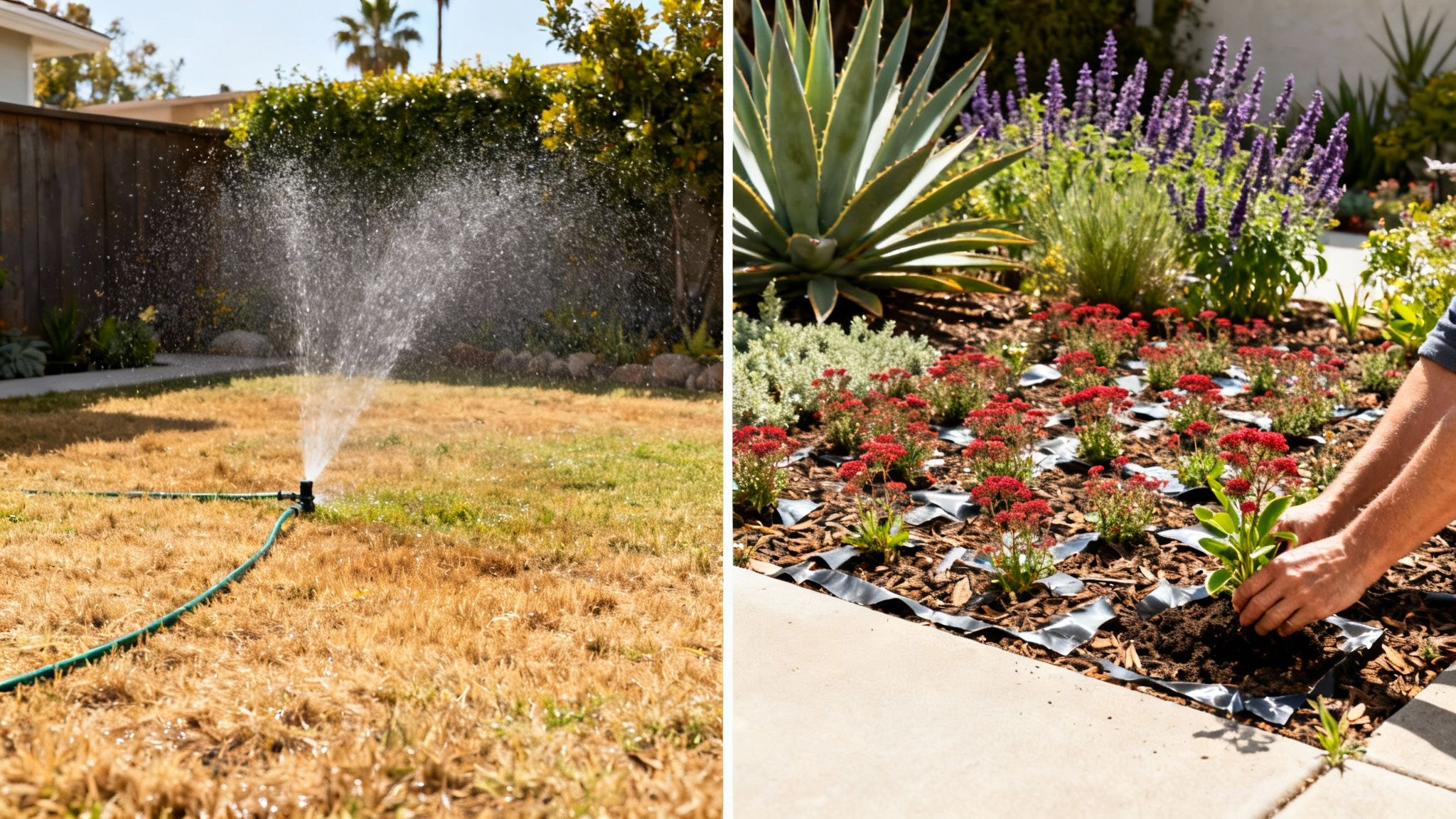
He needed plants that could thrive in his sunny, coastal yard. After some research, he chose a tough, beautiful team: the sculptural Shaw's Agave (Agave shawii), the pollinator-favorite 'Bee's Bliss' Sage (Salvia 'Bee's Bliss'), and the vibrant Red Buckwheat (Eriogonum grande var. rubescens). Following best practices, Sam sheet-mulched his lawn in late summer. That fall, with the first rains on the horizon, he planted his new natives.
The following spring, his once-sterile lawn erupted into a lively, buzzing habitat. Native bees swarmed the sage, and hummingbirds and butterflies became daily visitors. Sam’s experience is a perfect example of how any gardener can create a stunning, sustainable landscape that truly belongs.
Your Native Plant Gardening Questions, Answered
Jumping into the world of california native plants is exciting, but it's natural to have questions. Let's tackle some of the most common ones.
Can I Mix Native and Non-Native Plants?
Absolutely! The secret is smart grouping. Create zones in your yard based on water needs. Place your drought-savvy natives like Manzanita (Arctostaphylos) and California Lilac (Ceanothus) together, and keep thirstier non-natives in a separate area. This "hydrozoning" strategy allows for efficient watering without drowning your natives.
Do Natives Really Need Zero Summer Water?
This is a common myth. While established natives are incredibly drought-tolerant, they are not "no-water" plants, especially during their first year or two. Think of this as an establishment period where your job is to provide consistent, deep, but infrequent waterings to encourage a strong root system. Once mature, many natives will get by with very little or even no summer water, depending on your location.
When Is the Best Time to Plant?
If you remember one thing, make it this: plant in the fall. Planting from October through December is the absolute best thing you can do. This timing lets your plants use the cool weather and winter rains to establish deep roots before facing the stress of their first hot, dry summer.
Where Can I Buy California Native Plants?
Specialized nurseries that focus on our state's flora are your best bet. Many botanic gardens and local chapters of the California Native Plant Society (CNPS) also host fantastic seasonal plant sales. Supporting these growers aids conservation efforts. The CNPS monitors over 2,400 plant types considered rare or endangered in California, and native nurseries are essential partners in protecting this biodiversity. You can learn more about these conservation efforts directly from the CNPS.
It's Time to Grow a Garden That Belongs
Creating a garden with california native plants is one of the most rewarding things you can do. You’re not just planting flowers; you're rebuilding a piece of your local ecosystem, conserving precious water, and cultivating a landscape that is authentically Californian. It’s a powerful and satisfying journey.
By choosing plants evolved for your specific area and following these simple principles, you can create a gorgeous, low-maintenance garden that becomes more beautiful each year. The transition from a thirsty lawn to a vibrant, buzzing habitat is easier than you think. With the right support, finding the perfect local natives has never been simpler.
Discover your ideal native plants with Tendra - where local gardeners connect and thrive. Learn more at https://tendra-app.com.